Every summer, millions of people descend on the same twenty square kilometres of Tuscany. They queue for an hour to see the Leaning Tower. They crawl through Chianti traffic behind a convoy of rental Fiats. They pay €25 for a spritz in San Gimignano and wonder, quietly, whether this is really what they came for.
There is another Tuscany. It starts about forty minutes north of Lucca, where the road begins to climb and the tour buses stop appearing in your rear-view mirror.
The Valley They Forgot to Discover
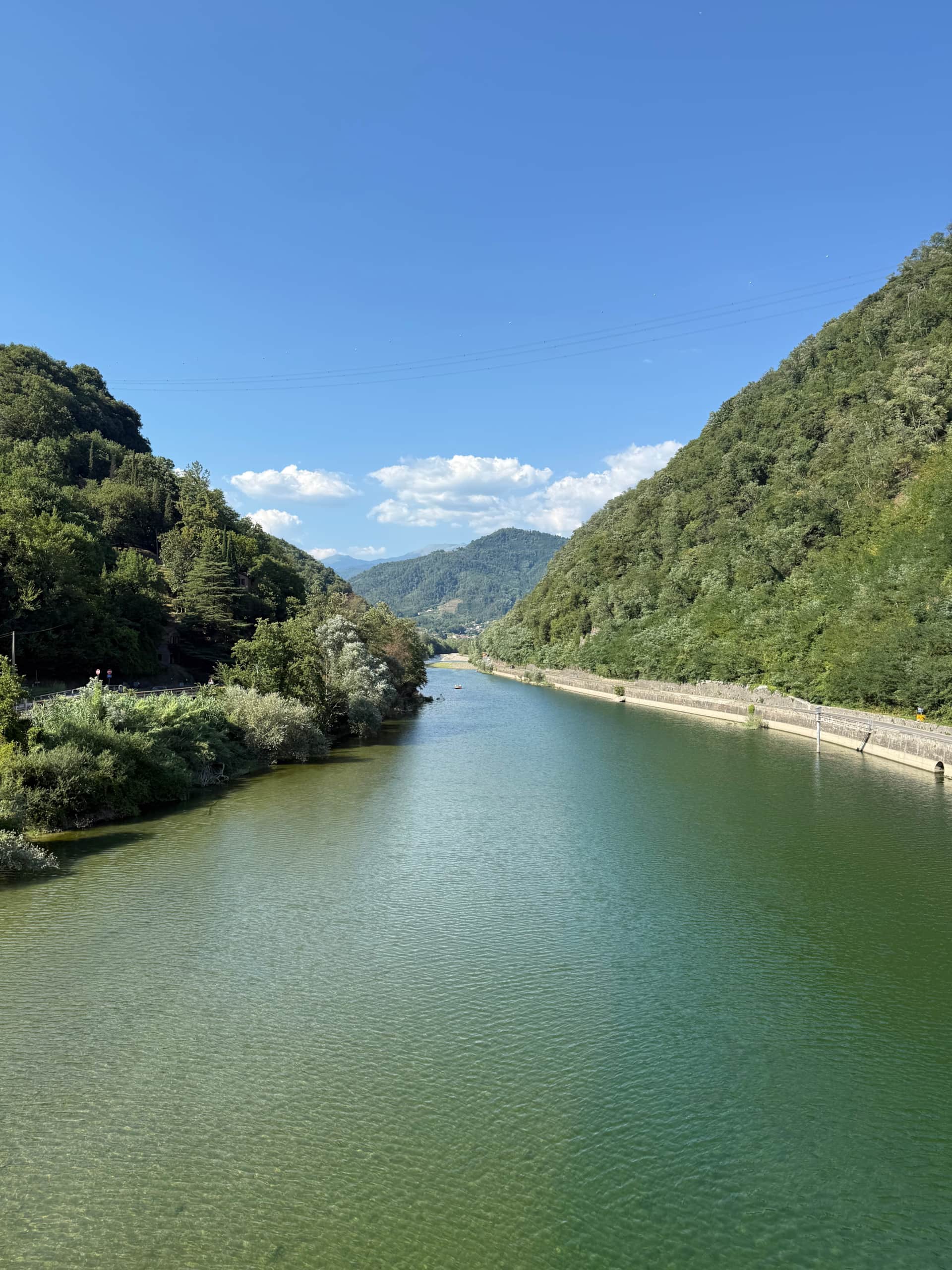
The Serchio Valley — Mediavalle in Italian — runs north from Lucca between two mountain ranges: the Apuan Alps to the west, the Tuscan-Emilian Apennines to the east. The river that gives it its name threads through the whole length of it, cold and fast, cutting gorges through limestone and past villages that haven't changed their skylines in five centuries.
This is not undiscovered Italy in the romantic-fiction sense. Italians have been coming here for generations — to the thermal baths at Bagni di Lucca, to the hill town of Barga with its white cathedral, to the chestnut forests above Castelnuovo di Garfagnana. What it lacks is the stuff that turns somewhere beautiful into somewhere exhausting.
There are no hop-on-hop-off buses. The restaurants don't have menus in six languages. The wine list at the village osteria might be handwritten on a chalkboard, and the waiter will tell you, with complete sincerity, that today you should have the ribollita.
You will not regret taking his advice.
The Devil's Bridge and a Very Old Bet
The valley's most famous landmark is in Borgo a Mozzano, a small town straddling the Serchio about 20 km north of Lucca. The Ponte della Maddalena — almost always called the Ponte del Diavolo, the Devil's Bridge — is an extraordinary piece of medieval engineering: a high-arched stone bridge built around 1080, asymmetrical, its tallest arch tall enough to sail a boat beneath.
The legend is that the local lord, struggling to finish the bridge before a deadline, made a deal with the devil: the bridge in exchange for the first soul to cross it. The devil agreed. The lord sent a dog.
Whether or not you believe the story, the bridge is worth the stop. Walk across it in the early morning before anyone else arrives, with the Serchio running fast below and the Apuan Alps catching the light above, and you will understand why people have been making journeys through here for a thousand years.
Which brings us to why they were making those journeys.
Two Roads to Rome (and One to Lucca)
The Serchio Valley sits at the intersection of two of Europe's great pilgrimage routes.
The Via Francigena — the road from Canterbury to Rome — passes through here. Sigeric, Archbishop of Canterbury, walked it in 990 AD and left a diary that historians still use to reconstruct the route. Medieval pilgrims in their tens of thousands followed him, heading south toward St Peter's. They crossed the Devil's Bridge. They stopped at the inns and chapels of Borgo a Mozzano. They were, in their way, the first tourists.
The Via Matildica del Volto Santo runs from Mantua to Lucca, where it joins the Francigena. It follows ancient roads through the Apennines and the Apuan Alps, tracing the route along which the Volto Santo — a revered wooden crucifix — was carried to Lucca in the eighth century. Villa Gran Burrone is literally on the Via Matildica — it runs through the village.
Both routes are walked today by thousands of modern pilgrims and long-distance hikers. If you're here in the valley, you're following a very long tradition of people who found that the right way to think is to walk somewhere.
Where to Eat: Two Restaurants Worth the Drive
The Serchio Valley is not a gastronomic destination in the sense that the food press has discovered it. It is a gastronomic destination in the better sense: the food is very good, it costs a reasonable amount of money, and no one is performing at you.
In Borgo a Mozzano, two restaurants stand out.
Osteria i Macelli is a proper Lucchese trattoria — the kind where the pasta is made that morning and the menu changes with what arrived from the market. It's the sort of place that's been feeding locals for decades and sees no reason to change.
Il Pescatore is the other one, and it has, in our entirely subjective but firmly held opinion, the best panna cotta in the world. Not the best in the valley. The world. It arrives looking like nothing special and tastes like someone has distilled the entire concept of cream into a single small dish. Order it even if you're not hungry. Especially if you're not hungry.
Day Trips That Actually Work
One of the valley's practical advantages is where it sits. It's genuinely central — not in the sense that every Italian tourist brochure claims everywhere is central, but in the sense that the distances actually work.
Lucca is 25–30 minutes south by car. The walled city is one of the best-preserved Renaissance urban spaces in Italy, and unlike Florence, it's still a real city where people live and work. Rent a bicycle, ride the walls, eat lunch in a piazza. The crowds are manageable except in high July and August.
Pisa is about an hour. Yes, go and see the tower. It genuinely is more beautiful in person than in photographs. Then ignore the tourist quarter entirely and spend the afternoon in the Piazza dei Cavalieri, which is where the Pisans themselves spend their time.
Florence is also about an hour — on a good day, on the A11. Book the Uffizi in advance (weeks in advance in summer), or accept that you're going to queue. The city is extraordinary and the queue is worth it. The best tactic: arrive early, go straight to the Botticelli rooms, work backwards.
The Versilian coast — Viareggio, Forte dei Marmi, and the beaches that run north toward the Cinque Terre — is about an hour west. This is where Florentines go in August, which means it's stylish, expensive, and very good. The sea is clear. The seafood is excellent.
For the more adventurous: the Garfagnana to the north, deeper into the mountains, is genuine wilderness — hiking trails, chestnut forests, small-batch olive oil producers, villages where the bar doubles as the post office. A morning up there and an afternoon by the pool is a very good day.
Where to Stay
We restored a medieval hamlet in the hills above Borgo a Mozzano. The property goes back to the 11th century — roughly the same era as the Devil's Bridge — and sits in the Apuan Alps with a private pool that looks out over the Serchio Valley.
There are four ensuite bedrooms sleeping eight. Carrara marble in the kitchen, a grand medieval hall with a fireplace, two hectares of private olive grove. Fast Wi-Fi and air conditioning, because a medieval shell is more comfortable with modern plumbing.
It's called Villa Gran Burrone — Gran Burrone being the Italian for Rivendell, Tolkien's hidden valley refuge. We think the name fits.
If you're looking for authentic northern Tuscany — real food, real landscape, real quiet — this is where to base yourself.